The Science and Policy Behind Water
The National Academies have released "Drinking Water: Understanding the Science and Policy Behind a Critical Resource". It is a free booklet designed to give the public a comprehensive introduction to drinking water issues.


Intel’s INSPIRE EMPOWER Challenge
Intel is calling for the best technology solutions to address four areas of global need – education, healthcare, economic development, and the environment. The contest will award seed funding of $100,000 USD to one winner in each category. The Challenge is designed to inspire developers, individuals, and organizations to innovate and empower them to deliver new ways to apply technology to these issues.
Create the Future Design Contest
The Create the Future Design Contest was launched in 2002 by the publishers of NASA Tech Briefs magazine to help stimulate and reward engineering innovation. The annual event has attracted more than 5,000 product design ideas from engineers, entrepreneurs, and students worldwide. Presented by SolidWorks Corporation, this year the contest is co-sponsored by COMSOL, Hewlett-Packard, and National Instruments.
The 2008 contest is open for entries until October 17, 2008.
Six categories:
* Consumer Products: Products that increase quality of life in the workplace, at home, during leisure time, or while traveling.
* Machinery, Equipment and Component Technology: Products that speed and improve work, manufacturing, or scientific research processes.
* Medical Products: Products that improve the efficiency and quality of healthcare.
* Safety and Security: Products that enhance the security or safety of individuals, businesses, communities, or nations.
* Sustainable Technologies: Products that help reduce dependence on non-renewable energy resources, as well as products designed for other purposes using environmentally friendly materials or manufacturing processes.
* Transportation: Products that enable movement of people and goods from one place to another.
Here are three of the most interesting inventions to emerge from this year’s contest:
 Moveable Braille Timepiece
 safety kitchen cutter
 ElectriLite Community Electric Vehicle
 wrist watch cum key holder
 ORIENS – reinventing the lifecycle of a plane
The 2008 contest is open for entries until October 17, 2008.
Six categories:
* Consumer Products: Products that increase quality of life in the workplace, at home, during leisure time, or while traveling.
* Machinery, Equipment and Component Technology: Products that speed and improve work, manufacturing, or scientific research processes.
* Medical Products: Products that improve the efficiency and quality of healthcare.
* Safety and Security: Products that enhance the security or safety of individuals, businesses, communities, or nations.
* Sustainable Technologies: Products that help reduce dependence on non-renewable energy resources, as well as products designed for other purposes using environmentally friendly materials or manufacturing processes.
* Transportation: Products that enable movement of people and goods from one place to another.
Here are three of the most interesting inventions to emerge from this year’s contest:
Moveable Braille Timepiece safety kitchen cutter ElectriLite Community Electric Vehicle wrist watch cum key holder ORIENS – reinventing the lifecycle of a planeThe entrepreneur success gap among different races
Education, prior work experience and financial backing are crucial factors in the success of entrepreneurs, according to a new book by Robert W. Fairlie and Alicia M. Robb and funded in part by the Ewing Marion Kauffman Foundation. The book examines why Asian American-owned businesses do well in comparison to white-owned businesses, and African American-owned firms do poorly in relation to both. The book also explores the broader question of why some small businesses succeed and others fail.
According to Race and Entrepreneurial Success: Black-, Asian-, and White-Owned Businesses in the United States, the most significant factors contributing to a firm's level of success are its startup capital and the owner's education level and business experience. The book, which was recently released by MIT Press, provides a new comprehensive analysis of Census Bureau data that are rarely seen by the public.
According to Race and Entrepreneurial Success: Black-, Asian-, and White-Owned Businesses in the United States, the most significant factors contributing to a firm's level of success are its startup capital and the owner's education level and business experience. The book, which was recently released by MIT Press, provides a new comprehensive analysis of Census Bureau data that are rarely seen by the public.
Financing Technology Enterprises in the Developing World
In developing countries, SMEs have great difficulty in obtaining the necessary financial resources to effectively scale up and grow their businesses. For SMEs competing in the ICT industry and ICT-enabled (ICTE) activities, the challenge of accessing growth capital is particularly acute. In the ICT/ICTE sector, industry specific aspects often limit the access to finance such as the high-tech nature of the business, which magnifies the informational asymmetries, or the intangible nature of assets that can be leveraged as collateral for loans.
This report, "Financing Technology Entrepreneurs & SMEs in Developing Countries: Challenges and Opportunities" by infoDev, traces the nature, extent, and root causes of the financing gap that plagues SMEs in the ICT/ICTE industry in developing countries. Results from this study confirm the existence of a financing gap, in the sense that seemingly well deserving ICT/ICTE operators have limited or no access to external financing when the stage of development of firms, the particular features of the various sub-sectors, and the conditions prevailing in different countries are taken into account.
This report, "Financing Technology Entrepreneurs & SMEs in Developing Countries: Challenges and Opportunities" by infoDev, traces the nature, extent, and root causes of the financing gap that plagues SMEs in the ICT/ICTE industry in developing countries. Results from this study confirm the existence of a financing gap, in the sense that seemingly well deserving ICT/ICTE operators have limited or no access to external financing when the stage of development of firms, the particular features of the various sub-sectors, and the conditions prevailing in different countries are taken into account.
The Agglomeration of U.S. Ethnic Inventors
The Agglomeration of U.S. Ethnic Inventors
Working Paper Publication Date: July 2008
HBS Working Paper Number: 09-003
Working Paper Publication Date: July 2008
HBS Working Paper Number: 09-003
The ethnic composition of US inventors is undergoing a significant transformation—with deep impacts for the overall agglomeration of US innovation. This study applies an ethnic-name database to individual US patent records to explore these trends with greater detail. The contributions of Chinese and Indian scientists and engineers to US technology formation increase dramatically in the 1990s. At the same time, these ethnic inventors became more spatially concentrated across US cities. The combination of these two factors helps stop and reverse long-term declines in overall inventor agglomeration evident in the 1970s and 1980s. The heightened ethnic agglomeration is particularly evident in industry patents for high-tech sectors, and similar trends are not found in institutions constrained from agglomerating (e.g., universities, government).
Wikipedia and Physics
Wikipedia needs more physicists
Seth Zenz
Symmetry, August 2008
Seth Zenz
Symmetry, August 2008
Wikipedia, the popular online encyclopedia, has often been criticized as having misinformation and inadequate references. By allowing any user to edit, it runs the risk of having “truth” defined by majority vote or a persistent vocal minority; it has the potential to deliver the public’s perception of science into the hands of fringe groups with an ax to grind.
XO Incubator
Our group with some participants in the International Development Design Summit have been designed an incubator for low birth weight babies in the developing world. 20 millons LBW babies born every year, 96% in the developing world. Incubators in developed countries are designed for hospitals: hard to repair, complex and expensive
We aim to imporve access to incubators and increase their effectiveness. It is a modular incubator: simple and adaptable with easily replaceable parts, allowing medical facilities to buy only what they need and to easily scale up over time. The incubator uses a XO laptop and low cost sensors for sensing medical signals.
The incubator will be used in rural health centers in the andes of Peru and manufactured locally by SMEs.
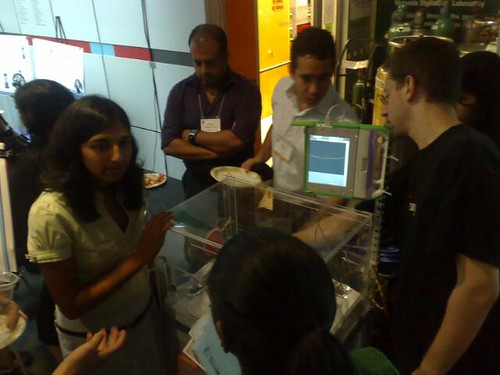
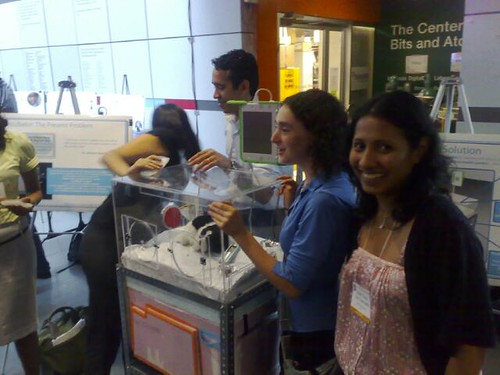
We aim to imporve access to incubators and increase their effectiveness. It is a modular incubator: simple and adaptable with easily replaceable parts, allowing medical facilities to buy only what they need and to easily scale up over time. The incubator uses a XO laptop and low cost sensors for sensing medical signals.
The incubator will be used in rural health centers in the andes of Peru and manufactured locally by SMEs.
Bayer Climate Award
This international award includes prize money of 50,000 Euros and will be awarded every two years by the Bayer Science & Education Foundation to excellent scientific achievements in the field of climate research. Works in basic research in the
areas of natural sciences and technical disciplines, which contribute to explaining climate change and which help dealing with its effects, are honoured. Currently, the following subjects are in the centre of attention: energy and environmental sciences, material sciences, process engineering, agronomy, plant economy, bio-technology and microbiology, polarography, oceanography and coastal research, physical-chemical, atmospheric research, geochemistry, geophysics and meteorology.
areas of natural sciences and technical disciplines, which contribute to explaining climate change and which help dealing with its effects, are honoured. Currently, the following subjects are in the centre of attention: energy and environmental sciences, material sciences, process engineering, agronomy, plant economy, bio-technology and microbiology, polarography, oceanography and coastal research, physical-chemical, atmospheric research, geochemistry, geophysics and meteorology.
The promise of mobile banking
In “Banking on Mobiles: Why, How, for Whom?” CGAP examines the business case and deployment options for smaller banks and microfinance institutions. With effective partnerships and technical choices, they believe there is a strong market opportunity to reach poor people with a broad range of financial services.
Development of Inventions and Creative Ideas
OCW: Development of Inventions and Creative Ideas
Spring 2008
Spring 2008
This course examines the role of the engineer as patent expert and as technical witness in court and patent interference and related proceedings. It discusses the rights and obligations of engineers in connection with educational institutions, government, and large and small businesses.
Offshoring of engineering
Offshoring of engineering activities has increased significantly in recent years across a range of industries, and will continue to expand in scale and sophistication, according to a new report from the National Academy of Engineering. The impact of offshoring has been mixed so far, with some U.S.-based companies benefiting while some individual U.S. engineers have lost their jobs or experienced slower salary growth, says the report "The Offshoring of Engineering: Facts, Unknowns, and Potential Implications".
Freedom Prize Competition
DOE and the Freedom Prize Foundation have announced the Freedom Prize competition to award $4 million for projects to reduce America’s consumption of foreign oil. The primary categories for the award are industry, K-12 schools, the military, state and local governments, and communities. Individual prizes will range from $500,000 to $1 million. Details about how to apply for the Freedom Prize are expected to be released in Fall 2008, with applications due in January 2009.
Subscribe to:
Posts (Atom)